clarity experiences platform
STOP. DO A REAL THING.
It is not too late to regain clarity and start living a life of intent and purpose.
The Problem
We are living in the world that has been intentionally engineered to steal or ability to focus, think clearly and do anything remotely meaningful. Peoples' inability to concentrate and lives lived in constant brain fog are the new realities. It is not you personally who are affected, we all are as a society, each group in their own distinct way. Rapid AI adoption and other disruptive patterns leave many people struggling to keep up and adjust to an ever increasing pace of modern day life.
Always on
Numbers don't lie. The young generation is drowning in digital noise and the consequences start to show.According to research of RIVM (Dutch National Institute for Public Health and the Environment), the share of young people with problematic social-media use has risen sharply in recent years.The U.S. Public Health Service reports that 95% of young people use social media, with up to one-third using it almost constantly. It warns that this poses a profound risk of harm to mental health, linking heavy use to anxiety, depression, sleep problems, and body-image issues.

Burned out
An ever-increasing number of people are suffering from work-induced mental health issues.According to research by TNO (Dutch Organization for Applied Scientific Research), an estimated 1.6 million employees in the Netherlands report burnout-related issues.Across Europe, nearly half of knowledge workers feel mentally and/or physically exhausted by the end of the working day and in the US, around 75% exhibit stress-related symptoms.On a global scale, as businesses continue to adopt AI solutions at an unprecedented rate, employees exhibit rising levels of anxiety and insecurity, recent research suggests. Much of this is driven by the pressure to stay relevant in what is often described as the biggest shift since the industrial revolution.
Distressed
These days, many people are in distress, being ripped out of their normal lives and routines, often stripped of their livelihood and hopes and dreams for the future.Dutch research on the well-being of undocumented migrants in the Netherlands shows how post-migration conditions strongly shape mental health, with many reporting ongoing psychological distress and deep uncertainty about their future.A working paper from Eurofound on the Ukraine crisis documents the heavy mental-health toll of displacement, describing widespread psychological strain among people forced to leave their homes, communities, and life plans behind.Many of them are able to settle and start anew, but once the elementary needs are satisfied, the question remains – what now? After a significant life event, people experience a measurable drop in mental clarity, routine stability, and sense of direction and this question often goes unanswered for months.You’re between chapters - everything feels uncertain. It’s not weakness, it’s the impact of disruption. Your system is trying to recalibrate, but it needs the right conditions to do that successfully.

The solution
Sometimes the only way forward is to step back and take a close look at your life – to sort things out and find a way to move forward. The truth is that it’s often the very environment you’re in that has pushed you into your current state.Environment in the broadest sense: the place you live, the routines you follow, the people and things you interact with every single day. Changing that environment, even briefly, is a proven way to recalibrate. What works for one person won’t work for another – but there are proven ways people have used to get their lives back on track.
Retreats and wellness
Meaningful rest that restores clarity
You spend most of your days reacting - to messages, deadlines, and other people’s needs. At one point you realize that another weekend just won't cut it, and that you need to take a step back to escape the noise and cognitive overload of the daily life.One of the first ideas to comes to mind is flying far away to a tropical island. While creating physical distance helps, intention is what ultimately matters. A change of scenery without a change of mindset does little. Sitting by the pool in Bali while doomscrolling short-form content isn’t a reset.


Walking and hiking
Movement designed to slow you down
Most of our lives are spent indoors, exposed to a constant stream of messages, deadlines, and noise. Intentionally slowing down and giving your mind space to wander is a scientifically proven countermeasure.It’s unsurprising that more people turn to seemingly unassuming walks and hikes, where the focus shifts to the movement of your body, the rhythm of your steps, and the calm that comes from being outside. A few hours can help you unwind, a few days can clear the mental fog and bring back clarity.
Positive impact
Purpose found through contribution
Giving back is a proven way to rediscover yourself. There is truth in the idea that value isn’t measured by how much you have, but how much you give. It’s rarely about the money, but rather about time, effort, and energy, about being part of something that is bigger than yourself.Modern life has a tendency to make you feel disconnected from others and yourself. Research shows that contribution and meaningful action enhance emotional well-being and may let people to finding their purpose.

The turning point
But then comes the real question – how? How do you even begin to break out of the patterns that keep you stuck? Maybe you can’t put your phone down for more than a few minutes. Maybe you’re overwhelmed, exhausted, burned out, or simply unsure what direction to take next. Whatever your situation may be, you don't have to fight this fight alone. There are ways forward, but no one can walk them for you. You have to make the leap – and I know exactly what it feels like.
My story
For many, there will come a moment that will make them stop and have a long hard look at themselves. For me, that moment came right before I turned 30.I realized that if nothing changes, nothing will change. If I kept going the way I was, I’d wake up decades later still in the same 9-5, with nothing meaningful to show for it. The pain of staying where I was has finally became greater than the pain of change.If you are not willing to make sacrifices for what you want, what you want becomes the sacrifice. For me, at that point, it was clear that something had to give.
Camino is
the way
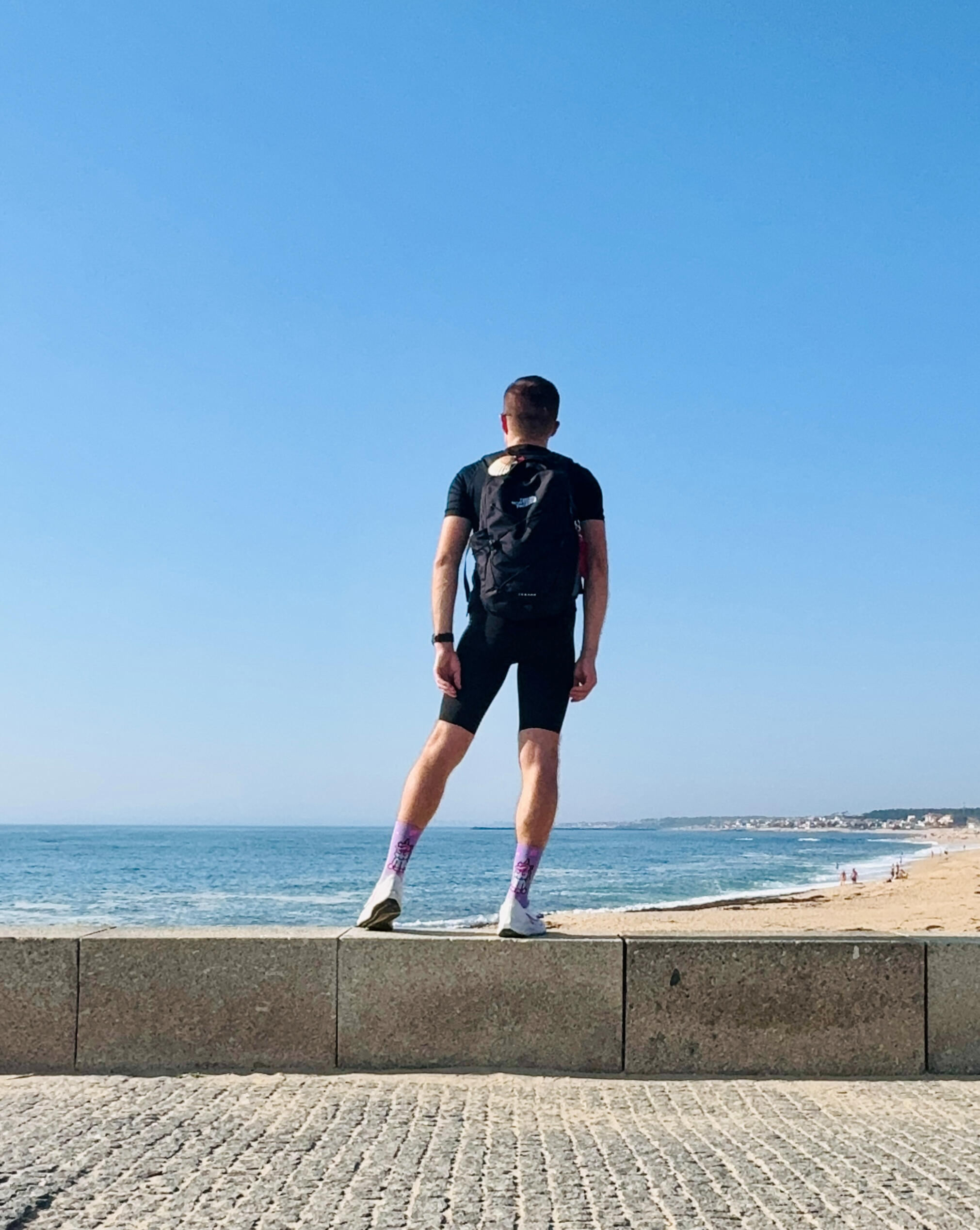
What I longed for was for someone to show me the way in an ever-changing world. That did not happen.Then, a thought came – What is a better place to find your way than on the Camino?Camino de Santiago has drawn people from all walks of life for centuries. Its magic is in simplicity – Camino doesn’t add, not in a traditional sense, instead, it subtracts. It takes away the noise, the clutter, and the decision fatigue.For an overstimulated and exhausted mind this simplicity becomes medicine. It provides room to reflect, to think, and to figure out what needs to happen next. It provides clarity.I wanted people to experience the same clarity that came to me on the way to Santiago. I want people to live a life of meaning, to live intentionally. The unfortunate truth is that many people live as if they are never going to die, and then die having never truly lived. I believed there had to be a solution.
Clarity Experiences
My first thought was to create an agency specializing in Camino trips, but we are all different and Camino couldn't be the answer for everyone. The question was - how could I help as many people as possible?Then came the realization – there already exist countless businesses who, each in their own way, help others experience something meaningful. What was missing was a way to bring them all together. A way to connect people with the right experience at the moment they need it.And so, Clarity Experiences was born – a platform that connects people who need meaningful experiences with the businesses who create them.Its purpose is simple: make it easy for anyone, anywhere, to find the experience they need to reflect, reflect, and realign.Together with our partners, we help people live with more clarity and intent – one meaningful experience at a time.
Retreats and wellness
Slow down, unplug, and reconnect with yourself in small-scale retreats, wellness stays, and mindful getaways.


Walking and hiking
Multi-day walks and hikes that clear your head step by step - from iconic routes to quiet trails.


Positive impact
Experiences where your reset also benefits others - through nature conservation and community projects.


Stay in the know
Read the most recent articles.


Thank you
Lorem ipsum dolor odio ut sem. Tempus iaculis urna lacus laoreet vel pharetra.
Meaningful Experiences Partner
Mindfulness & digital detox retreats in the mountains
MINDFULNESS · DIGITAL DETOX · NATURE-BASED · SMALL GROUPS
Hosted by Meaningful Experiences Partner in Austrian Alps. Languages: EN / NL.
About
Meaning Experience Partner creates small-group mindfulness and digital detox retreats in the Austrian Alps. Their programs are designed for people who feel constantly “on” and need time in nature to reset, breathe and think clearly again.3–5 day mindfulness & nature retreatsPhone-free digital detox weekendsSilent walking retreats and forest immersionsCustom small-group programs for teams
Highlights
First item
Second item
Third item
Partner 2
Aliquam sem fringilla ut morbi tincidunt augue interdum velit. Eu volutpat odio mauris. Risus quis sed diam. Pharetra neque ornare aenean.

Partner 3
Aliquam sem fringilla ut morbi tincidunt augue interdum velit. Eu volutpat odio mauris. Risus quis sed diam. Pharetra neque ornare aenean.

Partner 4
Aliquam sem fringilla ut morbi tincidunt augue interdum velit. Eu volutpat odio mauris. Risus quis sed diam. Pharetra neque ornare aenean.

Partner 5
Aliquam sem fringilla ut morbi tincidunt augue interdum velit. Eu volutpat odio mauris. Risus quis sed diam. Pharetra neque ornare aenean.

Partner 6
Aliquam sem fringilla ut morbi tincidunt augue interdum velit. Eu volutpat odio mauris. Risus quis sed diam. Pharetra neque ornare aenean.

Partner 7
Aliquam sem fringilla ut morbi tincidunt augue interdum velit. Eu volutpat odio mauris. Risus quis sed diam. Pharetra neque ornare aenean.

Partner 8
Aliquam sem fringilla ut morbi tincidunt augue interdum velit. Eu volutpat odio mauris. Risus quis sed diam. Pharetra neque ornare aenean.

Partner 9
Aliquam sem fringilla ut morbi tincidunt augue interdum velit. Eu volutpat odio mauris. Risus quis sed diam. Pharetra neque ornare aenean.

Partner 10
Aliquam sem fringilla ut morbi tincidunt augue interdum velit. Eu volutpat odio mauris. Risus quis sed diam. Pharetra neque ornare aenean.

Partner 11
Aliquam sem fringilla ut morbi tincidunt augue interdum velit. Eu volutpat odio mauris. Risus quis sed diam. Pharetra neque ornare aenean.

Partner 12
Aliquam sem fringilla ut morbi tincidunt augue interdum velit. Eu volutpat odio mauris. Risus quis sed diam. Pharetra neque ornare aenean.

Partner 13
Aliquam sem fringilla ut morbi tincidunt augue interdum velit. Eu volutpat odio mauris. Risus quis sed diam. Pharetra neque ornare aenean.

Partner 14
Aliquam sem fringilla ut morbi tincidunt augue interdum velit. Eu volutpat odio mauris. Risus quis sed diam. Pharetra neque ornare aenean.

Partner 15
Aliquam sem fringilla ut morbi tincidunt augue interdum velit. Eu volutpat odio mauris. Risus quis sed diam. Pharetra neque ornare aenean.

The Attention Trap
Always on, always distracted
We live in an always-on society. We are afraid of being left out of the loop, miss out on the latest news and notifications. We have FOMO caused by carefully curated social media feeds of others. We are chronically distracted, in continuous search of next dopamine hit to get us through the day.It has been scientifically established that we have lost the ability to maintain deep focus and concentration with an average office worker capable of concentrating on a task for just 3 minutes and a high school student for just 65 seconds. When you consider that nothing truly meaningful can be done without focusing first, this is at the very least concerning. Chances are, you are blaming yourself for the inability to focus. The truth is, you have not simply lost your ability to focus, but rather, it has been intentionally stolen from you.
Economics of attention
It should come as no surprise that Big Tech companies are profit-driven and one of the main ways they maximize their profit is by driving user engagement, i.e. keeping you glued to the screen for as long as possible. Attention is a valuable currency and the longer the time that user spends on a social media platform, the more ads he or she can be served and the more usage data can be collected.On average, a phone gets picked up around 205 times a day, and an average person has about 7 hours of screen time. That is roughly 49 hours per week, around 44% of a person’s waking hours assuming 8 hours of sleep. It gets more interesting when you consider that an average life expectancy in the US is 80 years. Taking the previous assumptions into account, this means that a person will spend roughly 23 years staring at a screen.Collectively, we should do more things that let us forget to pick up the phone. There have been numerous attempts in encouraging intentional behavior, with screen time monitoring and so-called dumb” phones. And while that might work on an individual level, it doesn’t solve the underlying problem.
Dead internet and brainrot
AI algorithms are continuously fine-tuned in order to perfect their ability to predict which content will keep each individual user glued to the screen the longest. Predictably, the next step is to generate the content users are fed.This ties in to the long-established dead internet theory in which an ever-increasing amount of content will be created by artificial intelligence rather than by humans. In hindsight, it could not have been predicted how rapidly the internet would be dying. Today, around three quarters of all new web pages contain AI-generated content, and roughly half of newly published articles are mostly written by AI. On some platforms, such as Meta’s Vibes, the share of AI-generated clips is effectively 100% by design.Continuous exposure to this this low-quality digital content has proven to cause a cognitive decline in humans, also known as brain rot. The phenomenon has become so widespread, that it has been named Harvard’s Word of the Year in 2024.
The (Re-)Shaped Mind
Introduce AI
Prior to the public introduction of ChatGPT in the fall of 2022, generative AI had been discussed only within a small part of the tech community. Just two years later, it has reached one billion active users. Considering that it took the internet 36 years to reach its first one billion users, and Facebook needed 8 years to reach the same milestone, the contrast is clear: technological adoption now moves at an unprecedented speed. For many, ChatGPT or one of its alternatives has already become an integral part of daily life, much like social media did in the decade before.
Voodoo doll
When you think of a voodoo doll, you probably imagine a handcrafted figure used in rituals to harm the person it represents. While that’s its historical origin, the modern version is far more unsettling – and it belongs to all of us. If you have ever been online, there is already a voodoo doll of you out there. Today it’s called a digital twin: a detailed online replica built from your clicks, searches, location, purchases, messages, and every trace you leave on the internet.This digital twin enables a level of personalization that was impossible a decade ago. Your social media feed isn’t random – it is tuned with surgical precision to show you the exact content most likely to keep you engaged. That part is well-established. What is newer is how people now interact with large language models. Take ChatGPT as an example: frequent users often reveal more about themselves in conversations with an AI than with their closest friends. Some rely on it for therapy-like support, life advice, or emotional intimacy. There have even been cases of people forming romantic attachments to AI companions, only to become devastated when the system’s memory was reset and the relationship vanished.As we grow more dependent on these systems, they grow more detailed, personal, and predictive. And that creates vulnerability. A digital twin is powerful – but it can also be exploited. Data leaks, profiling, manipulation, and hyper-personalized persuasion become real risks when something knows your fears, habits, desires, and blind spots. It’s like having a best friend who secretly shapes your worldview – not maliciously, but algorithmically – presenting a reality tailored specifically for you. At scale, this means no two people experience the same internet, the same information, or even the same version of truth. Algorithms don’t just respond to individuals; they divide individuals into their own private realities.
Cognitive decline
We are chronically hooked on technology that is feeding us content aimed to keep us glued to the screen. We are willingly sharing our data with AI systems and become ever more so reliant on them, while losing the ability to critically think. Brain is a muscle that, just like other muscles, needs to be stimulated, in order to not atrophy. Research has shown that our muscles start to slowly decline from the age of 30, and while there are promising initiatives that ultimately aim to achieve 100-year human life, what point does that have when you are unable to think? We are at an acute risk of quite literally losing our mind in both cognitive (physical) way; as well as agency over it, by having it highjacked by systems smarter than ourselves.“The future of AI is not about replacing humans; it’s about augmenting human capabilities.” – S. PichaiIt is tempting to outsource thinking to an AI system, to let it write an essay, or craft a presentation. AI should be used to assist us in meaningful ways and we should keep in mind that cognitive offloading is a risky practice.
The Age of AI
Mental Clarity and Intentional living in the Age of AI
AI has the potential to have a greater impact on our society than the industrial revolution and invention of electricity, there is a flip side that we need to be aware of. AI capabilities are compounding and becoming more powerful, more personalized, and more embedded in our lives. For already some time we have been living in an environment engineered for distraction, the race for our attention has been, like many things, enhanced using AI capabilities. As a result, algorithms now anticipate, predict and generate what we consume online with a sole purpose of driving user engagement. Our attention and time are some of the most precious commodities the corporations are after.It is evident that in this time of unprecedented technological acceleration, humanity as a whole will change and this raises the question of agency. AI is already able to think for us, but it’s up to us to make sure we keep thinking for ourselves. AI systems are getting smarter with each iteration, our reliance grows, while our attention and the ability to critically think diminishes. Most people lack basic tech literacy and are unable to use AI in mindful and intentional way.“AI is likely to be either the best or the worst thing to happen to humanity.” – E. MuskWe should aim to establish a sustainable and healthy relationship with AI that enables us to benefit from it and at the same time maintain cognitive clarity and mental autonomy. The need for clarity in the noisy, AI-driven world is urgent, it must be seen as a core value in the broadest sense, i.e. clarity of thought, of purpose and of identity.